Readers,
I’ve finished the next segment of Smart Tailoring with Kenneth King: preparing the body canvases to support the jacket fronts.

They turned out well.

As with the previous segments, Kenneth has a knack for making an arcane process comprehensible and easy to follow.
The object of this segment is to shape and buttress the body canvases so they can support the jacket fronts that will be riding on top.
The shaping is done with darts. Just as the jacket is shaped with darts, so is the body canvas. The difference is that in the canvas the return of the dart is dispatched with a rotary cutter.


Then Kenneth discusses an extra pattern piece called the shield, cut from tailor’s canvas, that covers the front shoulder.

Depending on the fabric, the garment, and the wearer, you can cut additional layers of canvas in graduated sizes and alternating grainlines for further reinforcement and definition of the shoulder.

He shows you how to draft these pieces–it’s easy–but in my case I think the base shield is enough for my jacket and fabric.

If I were making a military greatcoat from a heavy wool and wanted the garment to have a lot of shoulder definition I might very well use all the supporting cast of canvas shield pieces.

By the way, I checked the definition of “greatcoat” and came upon this discussion of overcoats, topcoats and greatcoats on Gentleman’s Gazette. I suddenly have a craving to tailor a substantial coat for Jack, or scale down a man’s sensible, durable coat style for myself.

Following this Smart Tailoring process is not only putting these ideas in my head, but getting me to think through what it would take to execute the ideas–and not being unnerved.
More and more, I’m reasoning out what support and shaping a garment would need “downstairs” using canvases, stays, and shoulder pads to create the best effect “upstairs” for the fabric and wearer. (Does it come as a surprise that I watch Downton Abbey?)

The shield is attached to the body canvas with pad stitching done on a flat surface. I’ve pad stitched before and have memories of tried patience and punctured fingertips, but this was a breeze, and thankfully thimble-free. (In the Savile Row tailoring class I took last year I never did find a thimble that fit.)
A theme I’m noticing in Smart Tailoring–and in Kenneth King’s work in general–is that when he recommends hand work, it’s because that method achieves an effect better than a machine can. “I like sewing by hand because I feel I have a lot more control,” he says.

But Kenneth King is no hand-stitching snob. A prefabricated product might work very well for a particular garment–and deadline.
“Now this is just something a lot of people don’t know,” he says. “If you really don’t want to go through all of this trouble to generate all of these pattern pieces, you can purchase fronts [for men’s jackets]. These are canvas fronts, pre-purchased… [A]s you can see down here in the bottom, they’re sized by jacket size. If you’re in a hurry, and you need to get tailoring done, it’s entirely legitimate.”
“You have the different options,” Kenneth says, referring to kinds and amounts of hand stitching and canvas reinforcements. But what I’m hearing is that all these foundational skills he’s teaching are making my options greater than ever. And that’s pretty exciting.
Next time, I’ll be basting the body canvases to their respective jacket fronts.
Related Posts


Hi Paula,
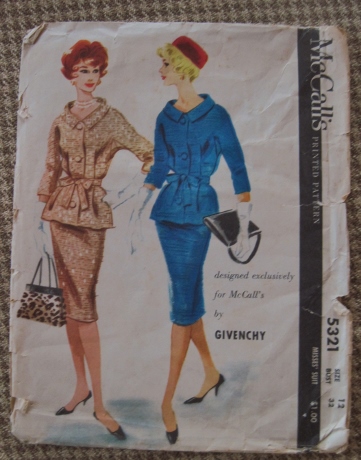
I’m really enjoying all of your posts on tailoring. I took a tailoring course back in the 80s at a local college. It was all old school like you are doing. But since I forgot much of what I learned, you are bringing it back to me very nicely. Kenneth’s method is similar with a few different twists that I like better. As for the “greatcoat”…You grabbed my attention there! Sewing coats was always my favorite thing to sew. I must have 100 coat patterns in my collection, my most recent being the mod styles from the 60s ( nostalgia I know). I have some great camelhair coating waiting in the wings and an old Vogue Ralph Lauren pattern 2784 of a Polo Coat ( Brooks Brothers had the exact coat) that would be perfect. After being inspired by your endeavors , I just might cut into it.
THANK YOU for your very interesting updates. Your work is lovely and I’m enjoying your professional progress immensely.
I’m guessing none of the hair canvas extends into the SA. I think it’s too bulky. The chest shield is 1/2″-3/4″ inside the SA at the neck edge and armscye, and abuts the roll line. I think only fusibles usually extend into the seam allowance.