Readers,
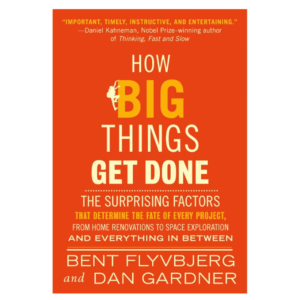
Nearly three years ago now, when I read about the then newly published book How Big Things Get Done: The Surprising Factors That Determine the Fate of Every Project, From Home Renovations to Space Exploration and Everything in Between, I couldn’t get my hands on a copy soon enough.
After all, not only am I an enthusiastic project-designer and -doer, I started a blog to help myself figure out how to design and do projects better and to report my findings to you.
“How is a vision turned into a plan that becomes a triumphant new reality?” Bent Flyvbjerg, a Danish economic geographer, Oxford professor, and “the world’s leading megaproject expert,” asks in the introduction. He answers, with refreshing brevity, “Think slow, act fast.”
The rest of How Big Things Get Done explains how most people and organizations do just the opposite–think too fast, and too little–or too much about the wrong things–and act too slowly, with dire consequences. If the project isn’t abandoned outright, it’s completed over budget and late, possibly not even then fulfilling the original intentions.
But some individuals and organizations have designed and executed multiple projects resulting in great successes. Flyvbjerg analyzes the processes that led to both the victories and defeats and lays out lessons that can be applied to projects of every size and kind.
My copy of How Big Things Get Done is riddled with red-penciled underlinings and plastered with Post-it notes. I’ve read the book through at least twice and recommended it to friends involved in projects from building a house to advising on a major airport expansion.
But–how relevant is How Big Things Get Done to getting things sewn? Very.
First, Flyvbjerg argues persuasively for planning. Too often, planning gets short shrift, being seen as the uncreative part of a project. Not so.
“A project begins with a vision that is, at best, a vague image of the glorious thing the project will become. Planning is pushing the vision to the point where it is sufficiently researched, analyzed, tested, and detailed that we can be confident we have a reliable road map of the way forward.” (p. 17)
Planning is also commonly seen as hampering a project by slowing things down. Flyvbjerg asserts the virtues of slowness.
“Not only is it safer for planning to be slow, it is good for planning to be slow…After all, cultivating ideas and innovations takes time. Spotting the implications of different options and approaches takes more time. Puzzling through complex problems, coming up with solutions, and putting them to the test take still more time. Planning requires thinking–and creative, critical, careful thinking is slow.” (p. 18)
Planning is also too often seen as an unnecessary addition to the project. Again, Flyvbjerg argues the opposite:
“Planning is working on the project. Progress in planning is progress on the project, often the most cost-effective progress you can achieve.”
Flyvbjerg doesn’t just make sweeping statements, he lays out detailed, real-life planning processes used for complex, high-stakes projects such as the Guggenheim Museum Bilbao by Frank Gehry and movies by renowned studio Pixar. These processes can be scaled down to what sewers do, which is more complex than might appear at first glance.
Second, Flyvbjerg argues for simplicity whenever possible. He warns readers not to be taken in by novelty for its own sake but to see virtues in modularity and repetition. What big things can be constructed from smaller, simpler units for outsized impact? Take Legos, a product of Flyvbjerg’s native Denmark: a model of simplicity:
“Modularity is a clunky word for the elegant idea of big things made from small things. A block of Lego is a small thing, but by assembling more than nine thousand of them, you can build one of the biggest sets Lego makes, a scale model of the Colosseum in Rome. That’s modularity.” (p. 162)
He continues,
“The core of modularity is repetition…Repetition is the genius of modularity; it enables experimentation…Repetition also generates experience, making your performance better. This is called ‘positive learning,’ as we saw earlier. Repetition rockets you up the learning curve, making each new iteration better, easier, cheaper, and faster.” (p. 163)
For getting things sewn, modularity and repetition mean creating slopers from which to design many patterns or fitting and altering a core set of commercial patterns that can be sewn many times, many ways.
Modularity and repetition can also be applied to standardizing the construction of recurring garment features like pockets, collars, facings, or zipper closures. Knowing you have those aspects squared away, you can concentrate on working with fussy fabrics, matching plaids, and other more advanced techniques.
Now, planning benefits greatly from data. For years I’ve been experimenting with collecting information on my sewing projects and making it easy to find again. I’ll describe tools I use, some of my own devising, and how they’ve helped me, in upcoming posts.
Related Posts